Best Built-In Grills
On this page
The best built-in grill is one whose burners suit the way you cook and whose cutout, fuel, power, and venting your island can support. Burner type and grate material decide how it cooks; the island decides whether it can be installed as planned, so work through both before you settle on a model.
| Line | What it makes for a built-in island | Burners and cooking surface |
|---|---|---|
| Lynx Professional | built-in gas grills, 30 to 54 in | Trident infrared and ceramic burners by model, stainless grates |
| Hestan | built-in gas grills | ask us for the current spec sheet |
| Coyote | built-in gas grills | ask us for the current spec sheet |
| Fontana Forni | wood, gas, and hybrid pizza ovens, including countertop models | not a grill; an island companion |
| Urban Bonfire | outdoor kitchen cabinetry | cabinetry first; also offers appliances and plumbing; ask us |
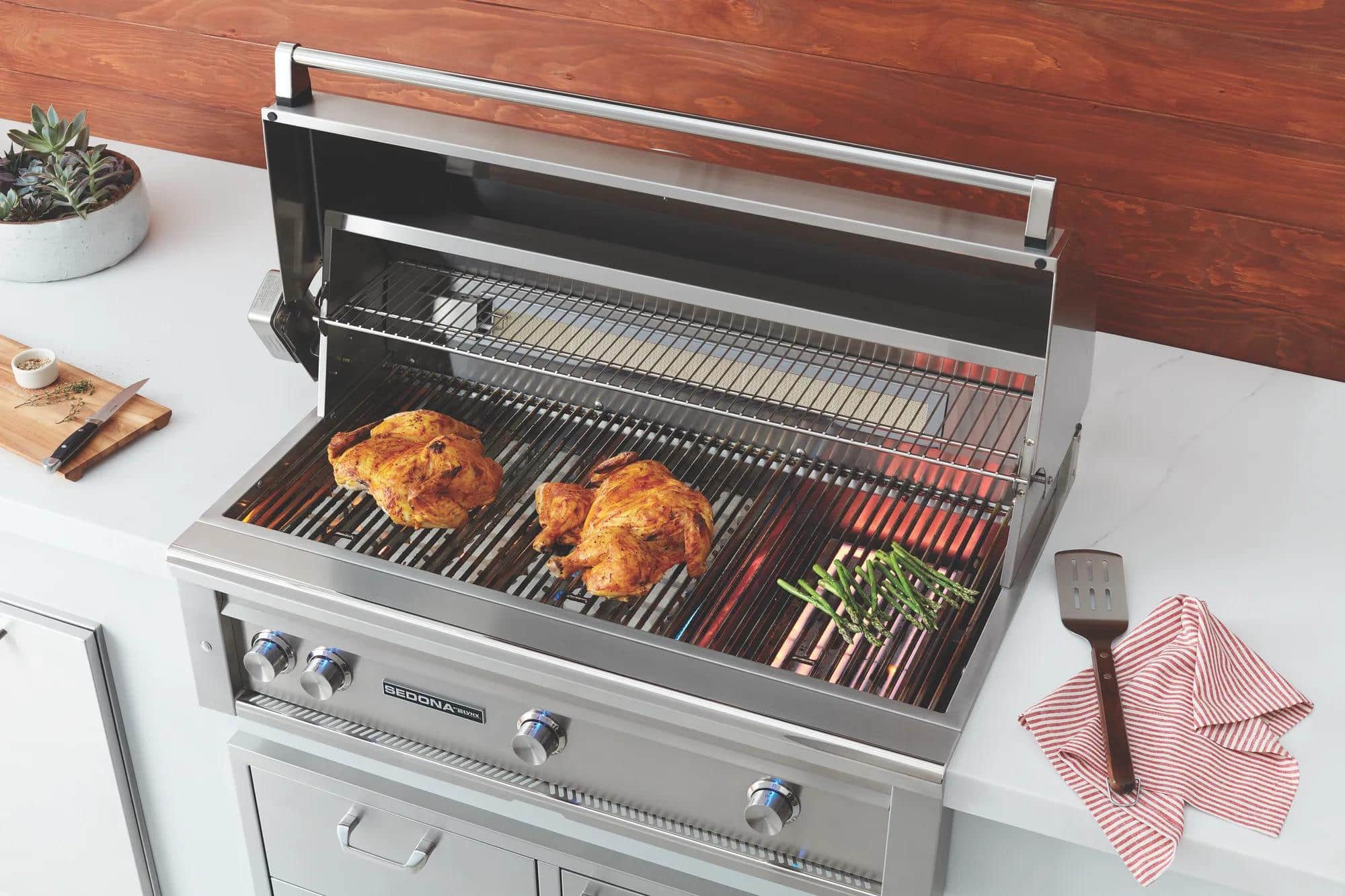
Burner types: infrared, ceramic, and stainless tube
Burners are the difference you'll feel most when cooking.
Infrared burners run very hot at the surface for searing. Lynx explains in its grill manual that its Trident infrared burner focuses the gas flame through a ceramic element full of tiny holes, which creates heat "much higher than that of a standard brass burner." Lynx also says to preheat the Trident before food goes on (2 to 3 minutes, or until it glows red, even when the grill is already hot) and not to use water to control flare-ups over it.
Ceramic and briquette systems spread the heat. The Lynx L30TR pairs one Trident infrared burner with one cast ceramic burner under ceramic briquettes, for up to 48,000 BTU, and adds a rear infrared rotisserie burner of up to 14,000 BTU.
Stainless tube burners spread the flame along a stainless tube under the grates. For Hestan built-in gas grills, ask us which burner types each model uses, and settle the configuration and cutout before the island is framed.
If you want hard searing and slower, even heat on the same grill, a mixed configuration (one infrared or sear zone plus standard burners) gives you both.
Grates and cooking surfaces
Lynx lists stainless steel grilling grates on its Professional built-in grills, including the L30TR. Grate material and thickness vary by line, so compare them on each spec sheet.
What a combustible island needs
Decide what the island is made of before you choose the grill. Ask your builder and local inspector whether it counts as combustible, because the makers below set different rules for a combustible island than for a non-combustible one.
- Lynx says installing into a combustible enclosure requires its insulated jacket accessory, and that the jacket must be supported from below by a ledge on each side or a full deck. Lynx lists a minimum distance to combustible construction of 12 inches from the sides and 6 1/4 inches from the back, and needs 3 inches behind the grill for the hood to open.
- Coyote says that if combustible material is within 24 inches of the grill frame, you must use the matching Coyote jacket, and that the jacket hangs from the countertop without support underneath and shouldn't be boxed in. Coyote also says the grill warranty will be voided if a jacket isn't used on a combustible island. Ask your builder or local inspector which materials count as combustible on your island.
Venting the island itself matters too, because gas can collect inside a closed cabinet. Lynx calls for ventilation holes in the enclosure, and each maker's installation guide sets the size and placement of the vents, so follow the one for your grill and fuel.
Natural gas or propane
Order the grill for the fuel you have. Lynx ships its Professional grills set up for propane or natural gas from the factory and sells conversion kits. Each maker publishes its own supply pressure requirement, so check it on the spec sheet for your fuel. A licensed gas fitter should size and run the line, and your local building department decides what needs a permit and inspection.
Power for lights, ignition, and the rotisserie
Many built-in gas grills with electric ignition, lights, or a rotisserie motor need a 120-volt outlet. Lynx calls for an outdoor 120-volt, 15-amp GFI outlet next to the grill, installed by a qualified electrician. For any other grill, check the power listing on its spec sheet. Have a licensed electrician place the outlet where the maker's cutout drawing shows it, before the countertop goes on.
Cooking under a roof or pergola
A covered patio changes the rules. Lynx says not to locate its grill under a roof or overhang or under unprotected combustible construction, and that if it is installed under any combustible construction, the cooking area must be covered by an exhaust hood approved for outdoor use, with 3 inches of overhang on all exposed sides, at least 1,200 CFM, and its own GFCI-protected circuit. If your plan puts the grill under a cover, choose the outdoor hood with the grill, not after.
Flat-tops and pizza ovens as island companions
A grill rarely stands alone in a full outdoor kitchen. EVO builds circular flat-top cooking surfaces; ask us for the current residential spec sheet.
Fontana Forni builds wood-fired, gas-fired, and hybrid pizza ovens in Italy, and says its countertop models are ideal for outdoor kitchens and can be added to an existing space. Urban Bonfire makes outdoor kitchen cabinetry, which it says is designed, manufactured, and tested in North America, and also offers appliances and plumbing.
Which grill fits which island
- You want serious searing
Look at Lynx's Trident infrared burners, or ask us about sear burner options on the other lines.
- You want even heat across a big surface
Lynx's ceramic burner models, or a grill with a full set of stainless tube burners.
- You cook a lot of eggs, vegetables, or seafood
Add an EVO flat-top beside the grill.
- You're building a wood-framed island
Choose the grill and its jacket together, and size the island to the jacket.
- You want cold storage in the same island
See outdoor-rated undercounter units before the cabinet run is framed.
- The grill goes under a roof
Plan the outdoor hood first. Browse our outdoor kitchen appliances and the Coyote line as well.
For what happens after you order, see delivery and installation after you order.
Questions to ask in the showroom
- Which burner mix suits how I cook, and does it change the cutout?
- Is my island combustible, and which jacket does this grill need?
- Natural gas or propane, and what supply pressure does the maker require?
- Where does the 120-volt outlet go, and does it need GFCI protection?
- Will the grill sit under a roof, and which outdoor hood would it need?
- Where do the island vents go for my fuel type?
Next steps in the Sacramento area
Start with planning an outdoor kitchen with our Sacramento-area team, then bring your island drawings, photos of the patio and any cover over it, and your fuel type to the Roseville showroom. We'll pull the current spec sheets and jacket cutouts with you before the island is framed. For indoor appliances, see all our buying guides.
Updated